Showing posts with label Images. Show all posts
Saturday, April 10, 2010
Saturday, February 13, 2010
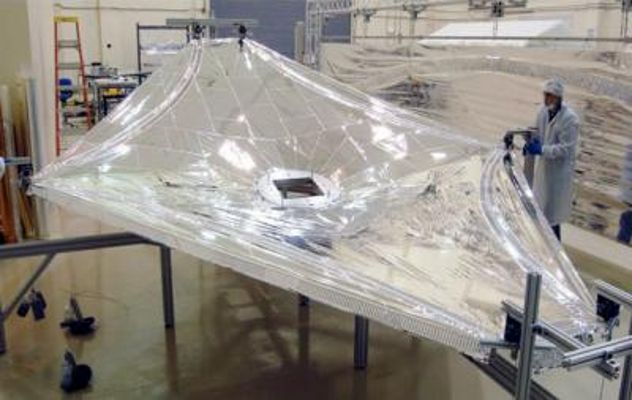
JWST Sunshield Passes Critical Design Review

Image comment: This is a photo of the 1/3 scale sunshield membranes undergoing final inspection at the Nexolve facility in Hunstville, Alabama. The full-scale sunshield will fly on the JWST in 2014
Image credits: Nexvolve
The James Webb Space Telescope (JWST) will be the largest observation instrument ever delivered into space during a single rocket launch. Only the International Space Station (ISS) will exceed it in size, but it will come nowhere near its capabilities of observing the early Universe in infrared wavelengths. But, in addition to the difficulties associated with deploying such a behemoth into orbit, engineers also need to figure out a way of protecting its highly sensitive instruments from stray radiation coming from the Sun, the Earth or the Moon. And this is where the shield steps in.
The tests took place between January 11-14, in Redondo Beach, California. “Passing this review is the culmination of years of intense effort meeting the unique challenges that have defined this mission. This is the first time a sunshield of this size and complexity will fly on a space telescope. We've achieved a very significant mission-critical milestone with this important validation of our sunshield design,” Northrop Grumman Aerospace Systems JWST telescope Program Manager Scott Willoughby says. The current design achieved thermal, deployment and stray-light targets, and is therefore ready to enter the manufacturing stage.
“There are no text books or guidelines on how to design and build a deployable sunshield of this size. Nearly a decade ago NASA and Northrop Grumman had to start from scratch and literally invent the techniques, materials, and mechanisms needed to do the job. We still have quite the challenge in front of us now that we start into the fabrication and testing phase but it's also a very exciting time,” GSFC JWST telescope sunshield Manager Keith Parrish shares. He adds that the tests consisted of 18 separate sub-assembly design audits, which were aimed at analyzing the performance of individual systems. Another thorough study was conducted on the points where these systems interlaced.
The Webb telescope is NASA's next-generation premier space observatory, exploring deep space phenomena from distant galaxies to nearby planets and stars. The Webb telescope will give scientists clues about the formation of the Universe and the evolution of our own solar system, from the first light after the Big Bang to the formation of star systems capable of supporting life on planets like the Earth. Expected to launch in 2014, the telescope is a joint project of NASA, the European Space Agency (ESA) and the Canadian Space Agency (CSA).
Tuesday, May 19, 2009
NASA's James Webb Space Telescope Unfolds by Animation
> View streaming Windows Media Viewer animation
Credit: Northrop Grumman Aerospace Systems
> View streaming Windows Media Viewer animation
Credit: Northrop Grumman Aerospace Systems
>View larger image
Credit: NASA
Although engineers, scientists and manufacturers are still in the process of building all of the instruments that will fly aboard NASA's James Webb Space Telescope, they had to figure out long ago, how it was going to "unfold" in space. That's because the Webb Telescope is so big that it has to be folded up for launch. Now, animators have made that "unfolding" come to life in two new videos.
A brand new animation of how NASA's massive next-generation space telescope will open up in space once it achieves orbit, was created by the Image center at Northrop Grumman Aerospace Systems, Redondo Beach, Calif. The Webb Telescope is roughly 65 feet (21 meters) from end to end and about 3 stories high.
"Animation helps designers and their colleagues to fully visualize and explain the complex motions required to deploy this observatory," said Mike Herriage, Webb Telescope Deputy Program Manager at Northrop Grumman. "And while it’s a visual tool, producing accurate animation is a technical challenge as well."
The James Webb Space Telescope is a large, infrared space telescope. It will find the first galaxies that formed in the early Universe, connecting the Big Bang to our own Milky Way Galaxy. It will peer through dusty clouds to see stars forming planetary systems, connecting the Milky Way to our own Solar System.
The Webb Telescope is extremely large and cannot fit in a rocket unless it is folded. It has a sunshield the size of a tennis court and an 18-segment mirror that looks like a honeycomb. Because of its large size, the telescope needs to be folded up to fit in the rocket. The sunshield will be compactly folded, much like a parachute, around the front and back of the telescope. The mirror segments are mounted on the "spine" or backplane of the telescope and the segments on the left and right sides of the honeycomb shape are folded in the rocket.
Once the Webb telescope is on its way to its final orbit, approximately 1 million miles from the Earth, engineers at Northrop Grumman will issue commands to the Webb Telescope to unfold it. "Think of the sunshield as five candy wrappers the size of a tennis court," said Mark Clampin, Webb Telescope Observatory Project Scientist at NASA’s Goddard Space Flight Center, Greenbelt, Md.
The animation shows the first part of the telescope to unfold is the solar panel, followed by the communications antenna. Next, the five layers of sunshield will drop into place from the front and back, spread out into a kite shape. The "secondary mirror support structure," an arm-like feature holding the secondary mirror assembly will then drop down from its folded center perch, and finally, the side mirror segments will be moved forward to form the complete "honeycomb."
"There are videos showing a simple deployment and a version that includes detailed views of key points in the sequence," Clampin said. "There are 2 and 4 megabyte versions of each video and they are high definition."
James Webb Space Telescope is a joint project of NASA, the European Space Agency and the Canadian Space Agency.
Subscribe to:
Posts (Atom)