Showing posts with label Specs. Show all posts

Wednesday, March 31, 2010

A View of the JWST NIRSpec Instrument


The Universe has always set the standard for colors. It produces all possible combinations of colors, granted not always in the visible light spectrum. But figuring out how these nuances intertwine is absolutely essential to, for example, determining the distance a certain object is from Earth, what chemicals it contains and so on. This is why the most impressive space observatory ever built, the James Webb Space Telescope (JWST), will feature an instrument perfectly capable of extracting this sort of data from whatever wavelengths of light enter its detectors.

The Near-Infrared Spectrograph (NIRSpec) device will be one of the most advanced spectrographs ever developed, and undoubtedly the most complex to ever fly to space. EADS/Astrium is the European Space Agency's (ESA) prime contractor for the overall NIRSpec instrument, but some of the components were constructed at the NASA Goddard Space Flight Center (GSFC), in Greenbelt, Maryland. The prototype for the actual NIRSpec instrument that will fly on the JWST recently arrived at the GSFC for preliminary testing, from its construction site in Germany.

“A spectrograph is an instrument that separates light into a spectrum. One example of a spectrograph that most folks know about is a chandelier (or diamond ring). When sunlight shines through it, it breaks it up into colors. NIRSpec analyzes those colors from deep space to help us solve mysteries,” explains GSFC expert Bernie Rauscher. He is the deputy project scientist of the telescope's Integrated Science Instrument Module (ISIM) and also the principal investigator of the NIRSpec Detector Subsystem.

This particular spectrograph will have the ability to analyze more than 100 cosmic objects at the same time, as its components were especially designed for this task. The instrument will collect readings in the infrared portion of the electromagnetic spectrum, which will enable researchers analyzing data from the instrument to determine the age, chemical composition and distances of faint galaxies. One of the primary mission goals for the James Webb Space Telescope will be to determine how galaxies began to form in the early Universe, and so this ability that the NIRSpec has will be absolutely fundamental to completing its mission.

Tuesday, May 19, 2009

JWST Science Presentation


How does JWST contrast with HST?


The James Webb Space Telescope (JWST) has been called the successor to the Hubble Space Telescope (HST). But what does this really mean? How will JWST be different than HST? There are some similarities - both telescopes are (or will be) in space. They both seek to improve our understanding of processes like star birth and the evolution of galaxies. However, there are many differences between HST and JWST.

For starters, JWST will primarily look at the Universe in the infrared, while HST studies it at optical and ultra-violet wavelengths. JWST also has a much bigger mirror than HST. This larger light collecting area means that JWST can peer farther back into time than HST is capable of doing. HST is in a very close orbit around the earth, while JWST will be 1.5 million kilometers (km) away at the second Lagrange (L2) point.

Read on to explore some of the details of what these differences mean.


Wavelength

JWST will observe primarily in the infrared and will have four science instruments that can take images and spectra of objects. These instruments will provide wavelength coverage from 0.6 to 28 micrometers (or "microns"; 1 micron is 1.0 x 10⁻⁶ meters). The infrared part of the electromagnetic spectrum goes from about 0.75 microns to a few hundred microns.. This means that JWST's instruments will work primarily in the infrared range of the electromagnetic spectrum, with some capability in the visible range.

The instruments on HST can observe a small portion of the infrared spectrum from 0.8 to 2.5 microns, but its primary capabilities are in the ultra-violet and visible parts of the spectrum from 0.1 to 0.8 microns.

EM Spectrum and  satellites

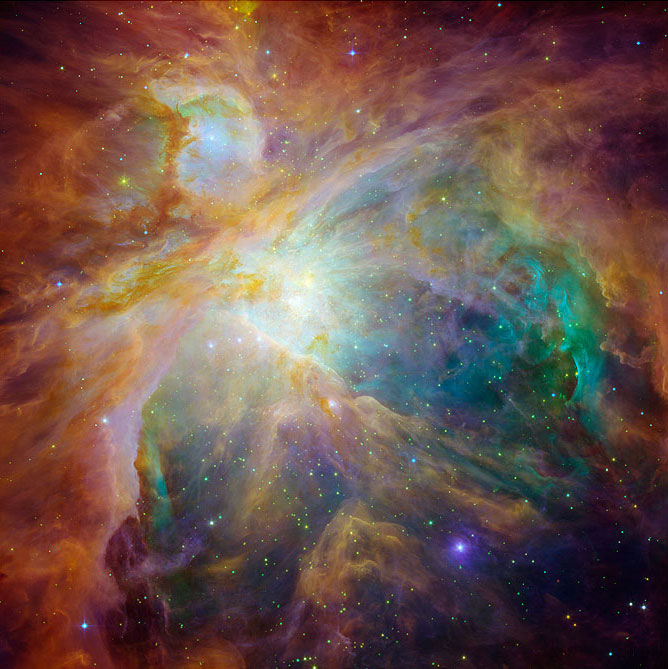
Orion  Nebula It is very important to make observations at different wavelengths as we get different information by looking at different wavelength bands. For example, stars and planets that are just forming lie hidden behind cocoons of dust and cannot be seen in visible light. The same is true for the very center of our Galaxy. However, infrared light can penetrate this dusty shroud and reveal what is inside. An example is the image of the Orion Nebula at left that combines Infrared and visible-light data from both the HST and the Spitzer Space Telescope.

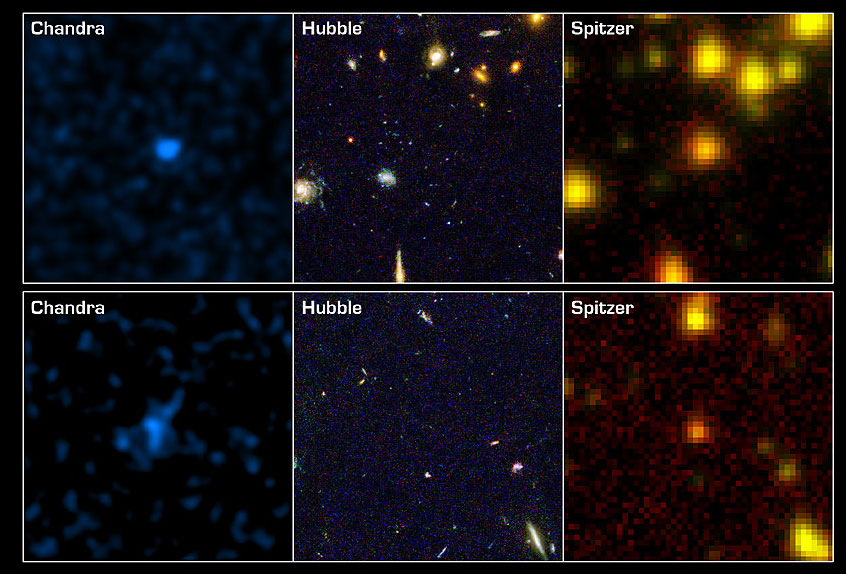
Orion Nebula Other objects may not emit visible or infrared light and may only emit X-rays. Or different regions of an object might emit light of a different wavelength than another region. We then need a telescope that can detect X-rays. Thus data obtained at different wavelengths can be combined to provide a more complete picture. For example, the image on the left shows the same two patches of sky, as viewed by an X-ray telescope (Chandra), a visible-light telescope (HST), and an infrared telescope (Spitzer). Each observation shows us something different (in this case, scientists were looking for black holes) - but combining these observations can give us a more complete (and more accurate) picture.
[top]


Size

size comparison HST is 13.2 meters (43.5 ft.) long and its maximum diameter is 4.2 meters (14 ft.) It is about the size of a large tractor-trailer truck. By contrast, JWST's sunshield is about 22 meters by 12 meters (72 ft x 39 ft). A Boeing 737-200 is 100 feet long!

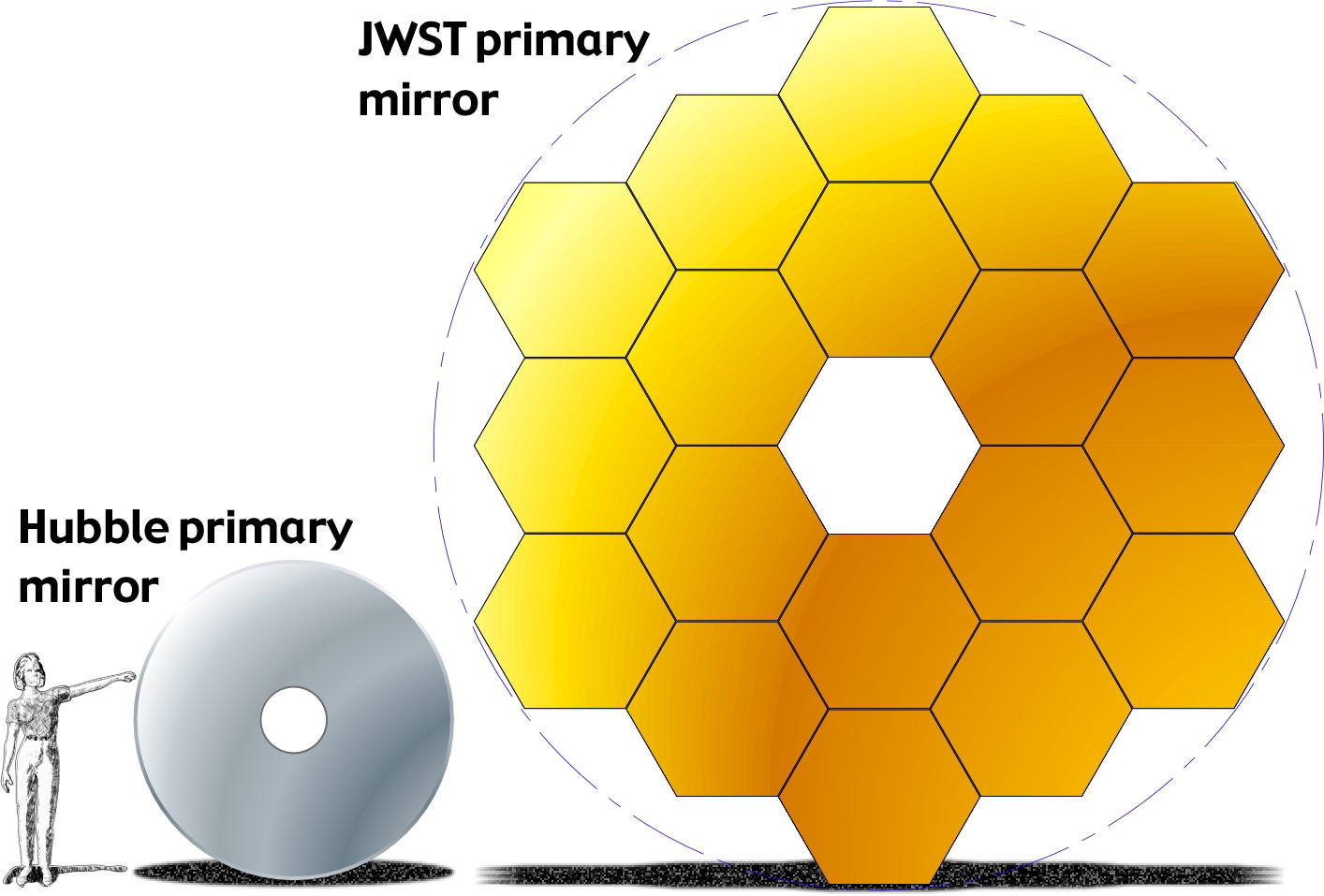
JWST and Hubble mirror  comparison JWST will have a 6.5 meter diameter primary mirror, which would give it a significant larger collecting area than the mirrors available on the current generation of space telescopes. HST's mirror is a much smaller 2.4 meters in diameter and its corresponding collecting area is 4.5 m2, giving JWST around 7 times more collecting area! JWST will have significantly larger field of view than the NICMOS camera on HST (covering more than ~15 times the area) and significantly better spatial resolution than is available with the infrared Spitzer Space Telescope.

[top]

Orbit

The Earth is 150 million km from the Sun and the moon orbits the earth at a distance of approximately 384,500 km.

earth sun distance  graphic

The Hubble Space Telescope orbits around the Earth at an altitude of ~570 km above it.

JWST will not actually orbit the Earth - instead it will sit at the L2 Lagrange point, 1.5 million km away! Because HST is in earth orbit, it was able to be launched into space by the space shuttle. JWST will be launched on an Ariane 5 rocket and because it won't be in earth orbit, it is not designed to be serviced by the space shuttle.

HST, JWST distance  graphic

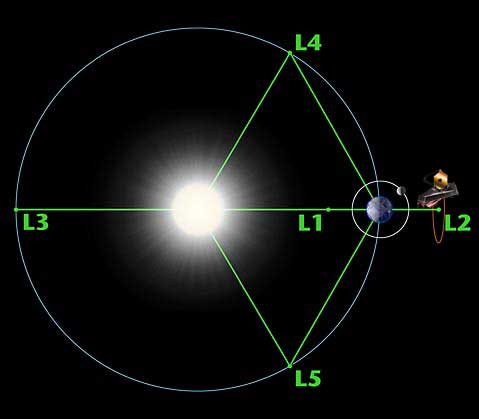
A Lagrange point is one of the five positions in interplanetary space where a small object (like a satellite) can be relatively stationary with respect to two larger objects (like the Earth and the Sun). It is analogous to an earth satellite in a geosynchronous orbit that allows it satellite to stay stationary over one spot on the Earth. At a Lagrange point, a satellite can stay "fixed" in space, rather than orbiting the Earth.

lagrange  diagram JWST will sit at the L2 point, with its solar shield blocking the light from the Sun, Earth, and Moon. This is very important as it will help JWST stay cool, which is very important for an infrared telescope. As the Earth orbits the Sun, JWST will orbit with it - but stay fixed in the same spot with relation to the Earth and the Sun, as shown in the diagram to the left.


Why does JWST need to be at L2?


JWST requires a distant orbit for several reasons. JWST will observe primarily the infrared light from faint and very distant objects. But all objects, including telescopes, also emit infrared light. To avoid swamping the very faint astronomical signals with radiation from the telescope, the telescope and its instruments must be very cold (Operating Temperature: under 50 K (-370 deg F)). Therefore, JWST has a large shield that blocks the light from the Sun, Earth, and Moon, which otherwise would heat up the telescope, and interfere with the observations.

To have this work, JWST must be in an orbit where all three of these objects are in about the same direction. The most convenient point is the second Lagrange point (L2) of the Sun-Earth system, a semi-stable point in the gravitational potential around the Sun and Earth. The L2 point lies outside Earth's orbit while it is going around the Sun, keeping all three in a line at all times. The combined gravitational forces of the Sun and the Earth can almost hold a spacecraft at this point, and it takes relatively little rocket thrust to keep the spacecraft near L2. The cold and stable temperature environment of the L2 point will allow JWST to make the very sensitive infrared observations needed.

JWST Instruments


The JWST instrument suite will consist of three science instruments. Unlike the Hubble Space Telescope, the JWST will be in a second Lagrange point orbit and will not be serviceable. Therefore, these will be the only instruments JWST will ever have.

JWST Science Instruments

MIRI Mid Infrared Instrument
NIRCam Near Infrared Camera
NIRSpec Near Infrared Spectrograph
FGS-TFI Fine Guidance Sensor Tunable Filter Imager


Supporting Hardware

ISIM Integrated Science Instrument Module
Guider Fine Guidance Sensor

JWST Design: The key elements of the Observatory


This Northrop Grumman SPIE article from Nov 2002 describes in more detail the selected architecture, its expected performance and the plans for integration and testing. Even though many details in the design have changed since the article was written, many of the design choices and procedures are still valid.

Instruments:

NIRCam


  • Near-IR and visible camera
  • Sensitive over the 0.6-5 micron wavelength range
  • Two broad- and intermediate-band imaging modules, each with a 2.2 x 2.2 arcmin field of view
  • Each imaging module has two channels, with light split by a dichroic at ~2.35 micron
  • Short wavelength channel 0.0317" pixels, long wavelength channel 0.0648" pixels
  • Each module has coronagraphic capabilities
NIRSpec
  • Multi-object dispersive spectrograph (MOS)
  • Sensitive over the 1-5 micron wavelength range
  • 3.4' x 3.4' field of view
  • ~0.1" pixels in the detector plane
  • R=1000 MOS Mode, 3 gratings cover 1.0-5.0 micron
  • R=2700 Integral Field Unit and Long-slit Modes
  • R=100 Prism, 0.6-5.0 mm in one exposure
  • Capable of observing more than 100 objects simultaneously using Multi-Shutter Assembly (developed by GSFC) with addressable 0.2 x 0.46 arcsec shutters
MIRI


  • Mid-IR camera and Integral Field Unit (IFU) and long-slit spectrograph
  • Sensitive over the 5-28 micron wavelength range
  • 1.88' x 1.27' field of view imaging, 12 filters
  • 3" x 3" IFU R=3000 spectrograph, in 5-10 and 10-27 micron channels
  • R=100 long-slit 5-10 micron spectrograph
  • Coronagraphic capabilities
FGS
  • Fine Guidance System
  • Enable stable pointing at the milli-arcsecond level
  • Sensitivity and field of view to allow guiding with 95% probability at any point on the sky (i.e. 95% at the galactic poles, better at most other places)
  • Tunable Filter Imager has one 2.2 x 2.2 arcmin field of view and selectable R~100 between 1.5-5.0 microns