Tuesday, March 30, 2010

Color It Ready - Webb Telescope Instrument Now at Goddard


The cosmos is filled with color, and color is a key in determining age, chemical composition and how far objects are from Earth. To help identify these colors and objects the James Webb Space Telescope will be using a spectrograph called NIRSpec. Recently, the engineering test unit for the Webb telescope's Near-Infrared Spectrograph (NIRSpec) instrument arrived at NASA's Goddard Space Flight Center, Greenbelt, Md. from its manufacturer in Germany for preliminary testing.

"A spectrograph is an instrument that separates light into a spectrum," said Bernie Rauscher of NASA Goddard. "One example of a spectrograph that most folks know about is a chandelier (or diamond ring). When sunlight shines through it, it breaks it up into colors. NIRSpec analyzes those colors from deep space to help us solve mysteries." Rauscher is the Principal Investigator for the NIRSpec Detector Subsystem and the Deputy Project Scientist of the Webb's Integrated Science Instrument Module (ISIM).

The NIRSpec instrument will be the principal spectrographic instrument on-board the Webb telescope.

The components that make up NIRSpec will be sensitive to infrared wavelengths from the most distant galaxies and will be capable of obtaining spectra of more than 100 objects in the cosmos simultaneously. Determining an object's spectra is important, because it will help scientists determine the age, chemical composition and distances of faint galaxies. These measurements are key to unraveling the history of galaxy formation in the early Universe - one of the primary science goals of the Webb mission.

One unique technology in the NIRSpec that enables it to obtain those 100 simultaneous spectra is a micro-electromechanical system called a "microshutter array." NIRSpec's microshutter cells, each approximately as wide as a human hair, have lids that open and close when a magnetic field is applied. Each cell can be controlled individually, allowing it to be opened or closed to view or block a portion of the sky. It is this adjustability that allows the instrument to do spectroscopy on so many objects simultaneously. Because the objects NIRSpec will be looking at are so far away and so faint, the instrument needs a way to block out the light of nearer bright objects. Microshutters operate similarly to people squinting to focus on an object by blocking out interfering light.

NASA Goddard has a lot invested in the NIRSpec. Goddard built NIRSpec's detector and microshutter systems. EADS/Astrium is the European Space Agency's (ESA) prime contractor for the overall NIRSpec instrument. The prototype instrument was integrated and tested at Astrium's facility in Munich, Germany, before being shipped to Goddard.

Now that it has arrived at Goddard, the NIRSpec engineering test unit will go through pre-integration testing with the ISIM, which acts as a "chassis" to the Webb telescope observatory. Along with the other instruments, NIRSpec will be fitted into the ISIM, which is also currently at Goddard. The engineering test unit reproduces the physical, thermal, electrical and optical (up to the Micro-Shutter Array unit) properties of the flight model.

The James Webb Space Telescope is the next-generation premier space observatory, exploring deep space phenomena from distant galaxies to nearby planets and stars. The Webb Telescope will give scientists clues about the formation of the universe and the evolution of our own solar system, from the first light after the Big Bang to the formation of star systems capable of supporting life on planets like Earth.

The Webb Telescope project is managed at NASA's Goddard Space Flight Center in Greenbelt, Md. The telescope is a joint project of NASA, the European Space Agency and the Canadian Space Agency, and will launch in 2014.

For information about NASA's James Webb Space Telescope, visit:

http://www.jwst.nasa.gov/

For more information about the NIRSpec, visit:

http://www.jwst.nasa.gov/nirspec.html

For more information, visit the NIRSpec website at the Space Telescope Science Institute:

http://www.stsci.edu/ngst/instruments/nirspec/

Extracting Information From Starlight


The cosmos is filled with stars. However, the closest star beyond the Sun is so far away, that it would take the fastest spacecraft 75,000 years to reach it. Astronomers can't study the cosmos by sending probes to gather information about other stars, as we do with our own Sun and its planets. Fortunately they don't have to. The information comes to us at the speed of light!

The light of stars is produced by atoms and molecules that encode, in the starlight itself, key science information about their chemical composition, temperature, pressure, and velocity. To receive and extract this information, astronomers will use the James Webb Space Telescope and a first-of-its kind science instrument whose prototype has just arrived at NASA's Goddard Space Flight Center, Greenbelt, Md. from its manufacturer in Germany.

The Webb telescope contains a giant 25 square meter (~30 square yard) mirror that will collect the faint light from distant stars and feed it to one of four science instruments that are each designed to extract a specific type of information contained in the light itself.

One of the most scientifically powerful instruments is a Near-Infrared multi-object Spectrograph (NIRSpec) that disperses the white star light into a spectrum so that the contribution of individual atoms and molecules in the star can be seen.

The atoms and molecules in the star imprint lines on this spectrum that uniquely fingerprint each chemical element and reveal a wealth of information about physical conditions in the star. Spectroscopy (the science of interpreting these lines), is among the sharpest tools in the shed for exploring the cosmos.

Many of the objects that the Webb will study, such as the first galaxies to form after the Big Bang, are so faint, that the Webb's giant mirror must stare at them for hundreds of hours in order to collect enough light to form a spectrum. In order to study thousands of galaxies during its 5 year mission, the NIRSpec is designed to observe 100 objects simultaneously.

The NIRSpec will be the first spectrograph in space that has this remarkable multi-object capability. To make it possible, Goddard scientists and engineers had to invent a new technology micro-shutter system to control how light enters the NIRSpec.

Although the night sky appears black, it's not really dark. If your eyes could see in the infrared, the night sky would appear to glow just as the daytime sky glows at visible wavelengths. The infrared glow of the night sky, known as the Zodiacal light, is produced by a cloud of dust that surrounds the Earth and Mars that the Webb must look through. Observing the first galaxies through this Zodiacal light, is analogous to observing stars during the daytime with your eye.

To prevent the NIRSpec from being blinded by the Zodiacal light, the Webb telescope forms a magnified image of the sky onto a programmable array of 250,000 shutters that are each the diameter of a human hair. Shutters under objects in this image for which a spectrum is desired, are commanded open allowing their light to enter the NIRSpec. The remaining shutters are held closed to minimize the Zodiacal light that can enter NIRSpec and reduce its sensitivity.

The NIRSpec micro-shutter system is one of 10 technologies that had to be invented to make the Webb mission possible. During the Webb mission, each shutter must withstand approximately 100,000 open/close cycles while operating at 40 K (-230 oC).

In order to make the large NIRSpec instrument light enough to fly on the Webb, its structure and optics are made of an advanced ceramic material called silicon carbide. The NIRSpec is among the most advanced astronomy instruments ever built.

NASA Goddard has a lot invested in the NIRSpec. Goddard built NIRSpec's detector and microshutter systems. EADS/Astrium is the European Space Agency's (ESA) prime contractor for the overall NIRSpec instrument. The prototype instrument was integrated and tested at Astrium's facility in Munich, Germany, before being shipped to Goddard.

Now that it has arrived at Goddard, the NIRSpec prototype will go through pre-integration testing with electronic and mechanical systems of the Webb's Integrated Science Instrument Module (ISIM). Along with the other prototype instruments, the NIRSpec will be fitted into the ISIM flight structure, which is also currently at Goddard.

These prototype instrument models are flight-like in form, fit, and function. They enable engineers to develop and practice integration and test procedures before handling the actual flight units.

The James Webb Space Telescope is the next-generation premier space observatory, exploring deep space phenomena from distant galaxies to nearby planets and stars. The Webb Telescope will give scientists clues about the formation of the universe and the evolution of our own solar system, from the first light after the Big Bang to the formation of star systems capable of supporting life on planets like Earth.

The Webb Telescope project is managed at NASA's Goddard Space Flight Center in Greenbelt, Md. The telescope is a joint project of NASA, the European Space Agency and the Canadian Space Agency, and will launch in 2014.

Friday, March 26, 2010

The Webb Telescope "Trailer"


The Webb Telescope will be the premier observatory of the next decade, serving thousands of astronomers worldwide. It will study every phase in the history of our Universe, ranging from the first luminous glows after the Big Bang, to the formation of solar systems capable of supporting life on planets like Earth, to the evolution of our own Solar System.

Formerly known as the "Next Generation Space Telescope" (NGST) and considered the successor to the Hubble Space Telescope, the telescope was renamed in Sept. 2002 after former NASA administrator, James Webb.


For more information about the Webb Telescope go to: http://www.jwst.nasa.gov/


Saturday, March 20, 2010

JWST MIRI Replica Arrives at NASA Goddard


Image comment: The MIRI Structural Thermal Model at the Science and Technology Facilities Council’s Rutherford Appleton Laboratory
Image credits: Science and Technology Facilities Council (STFC)

As the Hubble Space Telescope begins to approach its limits, the American space agency is currently working on creating a replacement. Called the James Webb Space Telescope (JWT), the new observatory will be the largest one ever delivered to orbit. However, designing it is very difficult, as some of the technologies that are needed to make it a reality have yet to be developed. But progress is taking place nonetheless, with the spacecraft's heat shields already clearing tests, and some of its mirrors completed. Now, the time has come to test one of its primary scientific instruments.

The Mid InfraRed Instrument (MIRI) is one of the most important components of the new telescope. As such, it needs to undergo extensive testing, so that engineers can ensure it's both highly sensitive, and resistant to the rigors of flying in outer space and surviving a rocket launch. As part of these efforts, a working replica of the MIRI has been recently delivered to the NASA Goddard Space Flight Center, in Greenbelt, Maryland. Experts here call the instrument “the pioneering camera and spectrometer for the James Webb Space Telescope,” Space Fellowship reports.

The replica came a long way to reach Goddard. It was recently shipped from the United Kingdom, where it was produced at the Rutherford Appleton Laboratory, a laboratory operated by the Science and Technology Facilities Council (STFC/RAL). The new observatory represents the fruit of an international collaboration that includes NASA, the European Space Agency (ESA) and the Canadian Space Agency (CSA). These organizations agreed that the best possible successor to Hubble was a telescope that would be larger, and also capable of observing the Universe in infrared wavelengths.

“Receipt of the MIRI structural thermal model (STM) represents a major milestone in eight years of development work by the joint European Space Agency (ESA) and NASA Jet Propulsion Laboratory (JPL) instrument team. Tests with this prototype model of the MIRI, conducted at Rutherford Appleton Laboratories in the UK, have shown that this science instrument is on track to meet all of its performance requirements. Upon receipt of the STM, Goddard engineers will begin testing it with supporting systems in the Webb telescope Integrated Science Instrument Module to facilitate smooth integration of the flight model,” JWST Science Instrument Payload project scientist Matt Greenhouse, who is based at Goddard, says.

Thursday, March 18, 2010

Turning up the heat: Finding out how well the Webb telescope's sunshield will perform


Keeping an infrared telescope at very cold operating temperatures isn't an option, it's an absolute necessity. For the James Webb Space Telescope to see the traces of infrared light generated by stars and galaxies billions of light years away, it must be kept at cryogenic temperatures of under 50 Kelvin (-370 F). Otherwise, sunlight would warm the telescope and this heat from the telescope itself will swamp the very faint astronomical signals, effectively blinding the telescope's eye. The job of the huge, five-layer sunshield is to keep that from happening.

Serving as a radiation blocker, the sunshield is subjected to nearly 100,000 thermal watts of solar heat, and reduces that to one tenth of a watt on the cold side, a million to one reduction.

But how do you test a complicated structure the size of a tennis court? There isn't a cryogenic chamber on the planet big enough and building one doesn't make sense from a budget and practical standpoint. So Webb engineers have constructed a 1/3-scale model and a test facility to perform the critical thermal test of the sunshield system.

The thermal test had two main goals: 1- to verify that the sunshield design can actually block and redirect the sun's energy before it reaches the telescope; and 2- to verify the accuracy of computer thermal models used to predict how the full-size sunshield will perform. 'The flight sunshield will be deployed and visually inspected prior to flight, but only a computer simulation of its thermal performance will be used to determine if it's ready to launch,' explains Keith Parrish, Webb telescope Sunshield Manager at NASA's Goddard Space Flight Centre, Greenbelt, Md.

'This is very similar to wind tunnel testing of large aircraft,' he notes. 'Most aircraft, especially large commercial airliners, are simply too large to undergo full-size testing. Computer models, which extrapolate the test data from smaller scale model wind tunnel tests, are used to verify final design and predict the full size aircraft's performance. Our Webb sunshield 1/3-scale model test is a very similar approach.'

In space, the sunshield will be heated by the sun. For ground testing, the 1/3-scale model was placed in a thermal vacuum test chamber at lead contractor Northrop Grumman's manufacturing facilities in Redondo Beach, Calif. The sun's heat was simulated by electrical heater plates placed very close to, but not touching layer 1, the warm sun- facing layer. Power to the heaters was steadily increased until layer 1 reached similar temperatures as those expected in flight, well over 100 degrees C (212 F, the boiling point of water at sea level).

Approximately 400 temperature sensors were placed all over the sunshield. 'We also keep an eye on the chamber's gaseous helium-refrigerated shroud temperatures and liquid helium cooling plates,' adds Parrish. 'These cooling plates simulate the cold background temperature of space at the orbit of Webb, which is around 7 Kelvin (-446.8 F). We can't get these plates all the way down to 7 K, which is pretty close to absolute zero. The plates typically get down to the 15 to 25 K (-434.4 F. to -414.4 F) temperature range, so exact knowledge of their temperature is critical to understanding the sunshield's performance.'

The engineering team used the 1/3-scale tests for a trial run of a device called a radiometer. Hung or mounted around the sunshield, these devices measure the heat radiation that is bouncing around and between the sunshield, the cold plates and the chamber walls. Since this kind of effect doesn't occur in space, it's important to understand how this heat bouncing impacts the test results. When the flight instruments and observatory are tested at Goddard and Johnson Space Centre, these devices need to be working well.

Seven different testing conditions were used to gather temperature data, and these test conditions were tailored so that engineers can study how the sunshield performs in space under a variety of conditions. Some test conditions exaggerated or increased temperatures and heat flows in specific areas of the sunshield. Even though these test conditions do not simulate flight conditions, they're designed to isolate and better define particular variables used in computer thermal simulations. 'One specific test condition used a mechanism in the chamber to change or warp the sunshield's shape,' Parrish explained. 'Since proper shape is critical to the sunshield's performance, this test condition gave engineers important data so they could see if computer models can actually predict the thermal impact of shape changes.'

After the temperature data was gathered, engineers ran computer models over and over again with small changes to mimic the actual test conditions. The goal is to better match the temperature data from the sensors on the sunshield to the computer models. 'This is really the critical part in the whole testing process,' says Parrish. 'Gathering the test data was just the beginning. Understanding that data and how it applies to the flight sunshield's predicted thermal performance is the critical step.'

To understand how the membrane shape affects thermal performance, a Light Detection And Ranging (LIDAR) laser device took highly accurate shape measurements on each of the five layers of the sunshield at room temperature. These measurements were used to validate the computer model predictions of each membrane under ambient conditions. The computer models were then used to predict the membrane shapes over the various test conditions.

Later this spring, the thermal chamber will be modified with a window so that the LIDAR device can see into the chamber and measure the shape of layer 5, the coldest layer, near its cryogenic operating temperature, approximately 77 K (-320.8 F). This test will allow the engineers to confirm if the computer model's prediction of shape at temperature is correct.

Careful planning and following rigourous procedures paid off - the test was very successful because all test objectives were met and engineers were able to collect the data they needed. That data is being carefully analysed to see if the test temperatures accurately reflect the thermal performance of the flight sunshield. Data analysis is a lengthy process scheduled to be complete by the end of March 2010.

The 1/3-scale tests go a long way in establishing model verification well in advance of the flight test. As a result, the fidelity of the master model is improved, which adds flight confidence and reduces technical risk.

The thermal testing took place over four weeks, from Nov. 23 to Dec. 19, 2009 in Northrop Grumman's largest thermal vacuum chamber at the company's Aerospace Systems manufacturing facilities in Redondo Beach, Calif.

Source: NASA/Goddard Space Flight Centre

Saturday, February 13, 2010

JWST Sunshield Passes Critical Design Review


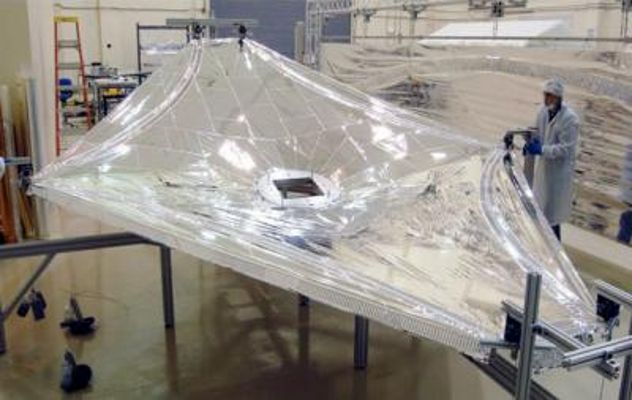
Image comment: This is a photo of the 1/3 scale sunshield membranes undergoing final inspection at the Nexolve facility in Hunstville, Alabama. The full-scale sunshield will fly on the JWST in 2014
Image credits: Nexvolve

The James Webb Space Telescope (JWST) will be the largest observation instrument ever delivered into space during a single rocket launch. Only the International Space Station (ISS) will exceed it in size, but it will come nowhere near its capabilities of observing the early Universe in infrared wavelengths. But, in addition to the difficulties associated with deploying such a behemoth into orbit, engineers also need to figure out a way of protecting its highly sensitive instruments from stray radiation coming from the Sun, the Earth or the Moon. And this is where the shield steps in.

The sunshield the JWST will employ is about the size of a tennis court, and is made up of five overlapping layers of material. Its mission is fairly straightforward, namely to prevent any photons from entering the telescope's mirrors. Just recently, the shield passed a design review test, the most important it had to face. The investigation determined that the design stage was complete, and that the structure met mission requirements. It is being developed by Northrop Grumman, a corporation that has been contracted by the NASA Goddard Space Flight Center, in Greenbelt, Maryland.

The tests took place between January 11-14, in Redondo Beach, California. “Passing this review is the culmination of years of intense effort meeting the unique challenges that have defined this mission. This is the first time a sunshield of this size and complexity will fly on a space telescope. We've achieved a very significant mission-critical milestone with this important validation of our sunshield design,” Northrop Grumman Aerospace Systems JWST telescope Program Manager Scott Willoughby says. The current design achieved thermal, deployment and stray-light targets, and is therefore ready to enter the manufacturing stage.

“There are no text books or guidelines on how to design and build a deployable sunshield of this size. Nearly a decade ago NASA and Northrop Grumman had to start from scratch and literally invent the techniques, materials, and mechanisms needed to do the job. We still have quite the challenge in front of us now that we start into the fabrication and testing phase but it's also a very exciting time,” GSFC JWST telescope sunshield Manager Keith Parrish shares. He adds that the tests consisted of 18 separate sub-assembly design audits, which were aimed at analyzing the performance of individual systems. Another thorough study was conducted on the points where these systems interlaced.

The Webb telescope is NASA's next-generation premier space observatory, exploring deep space phenomena from distant galaxies to nearby planets and stars. The Webb telescope will give scientists clues about the formation of the Universe and the evolution of our own solar system, from the first light after the Big Bang to the formation of star systems capable of supporting life on planets like the Earth. Expected to launch in 2014, the telescope is a joint project of NASA, the European Space Agency (ESA) and the Canadian Space Agency (CSA).

Tuesday, July 7, 2009

James Webb Space Telescope Core Completes Thermal Testing


JWST model core is shown being lowered into a staging area, where the gaseous helium shroud (shown at left of picture) will be draped over the core before it is installed into the thermal vacuum chamber.

REDONDO BEACH, Calif., (Northrop Grumman) — Northrop Grumman Corporation (NYSE:NOC) has completed testing on a model of the “core” section of NASA’s James Webb Space Telescope (JWST) to validate the observatory’s sophisticated thermal modeling and design. The company is leading an industrial team in the design and development of the Webb Telescope for NASA Goddard Space Flight Center.

“This test represents JWST’s first large-scale thermal performance and demonstration test after a decade in development,” said Martin Mohan, JWST program manager for Northrop Grumman’s Aerospace Systems sector. “At this early juncture, it appears that our test objectives were achieved. The team gathered a tremendous amount of data that we’ll review over the coming months to assess the implications for the current observatory design.”

The Webb Telescope’s unique design features a sunshield that separates the observatory into a warm sun-facing side, and a cold side facing away from the sun. The warm side will be subjected to nearly 100,000 thermal Watts of heat from the sun, while the cold, anti-sun side, where the optical telescope element and science instrument module are located, will be cooled passively to as low as -414 degrees Fahrenheit (25 K, or slightly above absolute zero). These elements come together at the observatory’s central, or core, region.

The core model built by Northrop Grumman is a thermal facsimile of the Webb Telescope’s central region and stands about two stories tall, or 17.5 feet, and 17 feet wide. It consists of the top portion of the spacecraft bus, deployable tower, a truncated but fully tensioned five-layer sunshield, optical telescope element backplane support frame, integrated science instrument module (ISIM) compartment, cable trays, thermal management systems, and ISIM electronics compartment.

Testing was conducted in Northrop Grumman’s largest thermal vacuum chamber at the company’s space systems manufacturing facilities over nearly six weeks. To simulate the extreme cold JWST will experience in space, Northrop Grumman upgraded the chamber with a gaseous helium-refrigerated shroud and precisely monitored the test with 550 individual temperature sensors. The chamber provided a background operating temperature as low as -435 degrees F (13K).

The telescope operates at temperatures approaching absolute zero to best see the near- and mid-infrared light coming from the very first stars and galaxies.

“I can’t overstate how much of a milestone this test represents and the remarkable achievement it is just getting this large test article to flight-like temperatures and gathering the needed data,” said Keith Parrish, NASA Goddard Space Flight Center, JWST Deputy Observatory/Sunshield manager. “The fact that it went as smoothly and with as little fanfare speaks volumes to the planning, build quality, facility operations, and foresight of the entire team. This test expands the joint NGAS/NASA institutional knowledge for large cryogenic testing and will contribute to the even more complex flight article testing later in the program.”

The Webb Telescope is the next-generation premier space observatory, exploring deep space phenomena such as distant galaxies to nearby planets and stars. It will give scientists clues about the formation of the universe and the evolution of our own solar system, from the first light after the Big Bang to the formation of star systems capable of supporting life on planets like Earth.